Beyond the Revolver: The Wild Weapons of the Italian West
From Gatling guns in coffins to multi-barrel derringers, exploring the absurd arsenal of the Spaghetti Western.

The classic American Western was built on a foundation of historical reverence, and nowhere was this more apparent than in its weaponry. The Colt Single Action Army (the "Peacemaker") and the Winchester rifle were treated not just as tools, but as sacred artifacts of civilization. Italian filmmakers, however, had zero interest in historical accuracy. For them, a gun was an instrument of style, surprise, and excessive destruction.
In the Spaghetti Western, the weapon often defined the man. It was an extension of his personality, his cunning, and his theatricality. As the genre exploded in the late 1960s, directors engaged in a literal arms race, trying to outdo each other with increasingly absurd, inventive, and devastating firearms.
The Coffin and the Machine Gun
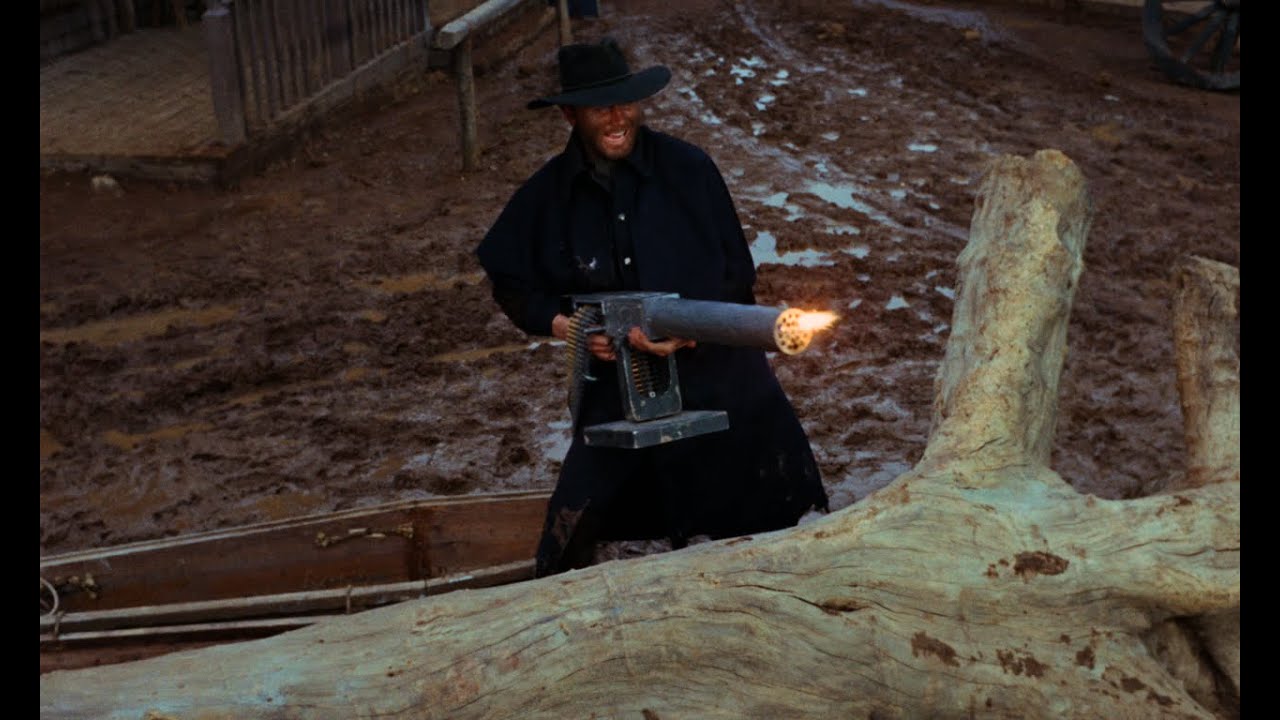
The most famous departure from traditional Western weaponry arrived in 1966 with Sergio Corbucci's Django. For the first act of the film, Franco Nero's titular character drags a mysterious, mud-caked coffin behind him. When he is finally cornered by Major Jackson and his dozens of red-hooded henchmen, Django doesn't draw a revolver. He kicks open the coffin, pulls out a massive, multi-barrel Gatling gun, and mows down the entire gang in seconds.
This scene was a revelation. It shattered the concept of the "fair fight" that defined the American Western. Django didn't win through faster reflexes or superior morality; he won through overwhelming, industrialized firepower. The Gatling gun became the ultimate symbol of the Spaghetti Western's disregard for the rules.
Sabata and the Art of the Derringer

If Django was a blunt instrument, Lee Van Cleef's Sabata was a surgeon. Sabata was defined by his use of small, hidden, and highly customized weaponry. His signature piece was a derringer, but not a standard two-shot pocket pistol. Sabata's derringer featured four barrels, and the grip concealed additional barrels that could be fired when the gun was held upside down or even thrown.
In the Sabata films, gunplay was treated less like combat and more like a magic trick. The suspense didn't come from wondering who would draw faster, but from wondering where Sabata's next bullet was going to come from. His arsenal included rifles with extended barrels that could shoot targets miles away, and even banjos rigged with hidden barrels.
Armor and Explosives
The innovation didn't stop at firearms. In Sergio Leone's A Fistful of Dollars, Clint Eastwood's character survives a duel with the lethal Ramon Rojo by wearing a makeshift bulletproof vest made from a heavy iron stove door. It was a brilliant, practical piece of trickery that perfectly encapsulated the genre's ethos of survival by any means necessary.
Explosives also became a staple. In Duck, You Sucker! (also known as A Fistful of Dynamite), the character of John Mallory (James Coburn) is an IRA explosives expert who carries nitroglycerin in his coat pockets and wears a motorcycle jacket festooned with dynamite. He uses explosions not just as weapons, but as a form of communication and problem-solving.
The Legacy of the Arsenal
The obsession with unique weaponry became a hallmark of the genre, continuing into its twilight years. In films like Sartana, the protagonist uses a pocket watch that doubles as a smoke bomb, and in The Specialists, the villain uses chainmail armor to deflect bullets.
These wild weapons perfectly captured the spirit of the Spaghetti Western: loud, theatrical, deeply cynical, and endlessly creative. They reminded audiences that in the Italian West, survival wasn't about who was right or wrong, but who had the biggest, smartest, or most ridiculous gun.
About the Author: Spaghetti Cinema Research Team
Specializing in the intersection of musicology and 1960s European cinema.